Introduction
When specifying wall reinforcement for large-scale construction, the search for a reliable fiberglass mesh for wall supplier often centers on the balance between alkali resistance and tensile strength. In high-humidity or cement-heavy environments, standard meshes frequently fail due to chemical erosion, leading to surface cracks and structural degradation. The challenge for procurement managers is identifying a source that provides consistent material purity and weaving precision across thousands of square meters.
The criticality of this selection extends beyond simple aesthetics; it impacts the lifecycle of the entire wall system. By integrating specialized alkali-resistant fiberglass fabric, builders can significantly reduce the risk of shrinkage cracks in plastering and EIFS (Exterior Insulation and Finish Systems). This is where the synergy between high-modulus fiberglass yarn and advanced heat-finishing coatings becomes essential, ensuring that the reinforcement does not degrade when embedded in alkaline cementitious matrices.
Navigating the technical specifications of various mesh grades requires a deep understanding of weight, mesh size, and coating quality. This guide analyzes the critical metrics for selecting a fiberglass mesh for wall supplier, focusing on how material composition and manufacturing precision influence long-term wall stability in diverse architectural applications.

Technical Composition of Alkali-Resistant Wall Mesh

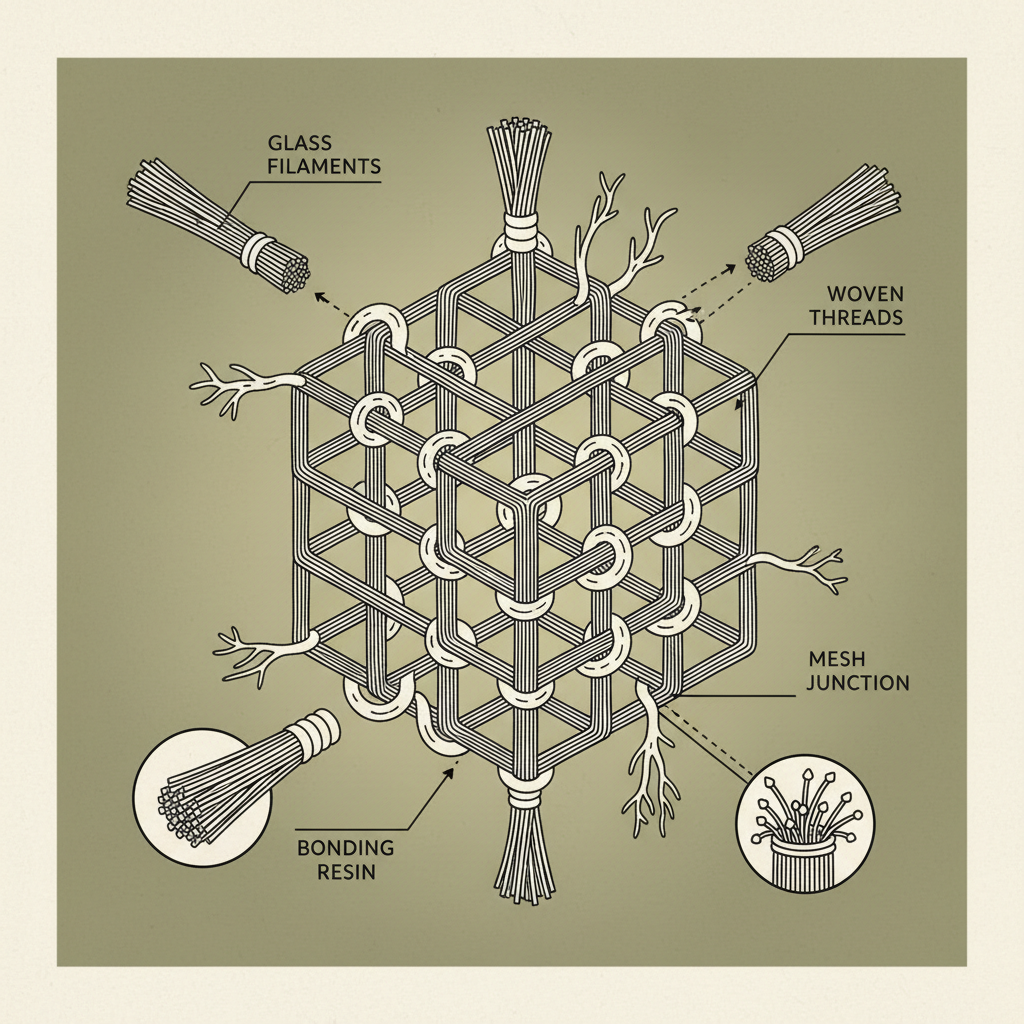
The structural integrity of wall mesh depends on the base yarn—typically C-glass or E-glass fiber. To prevent the glass from dissolving in the highly alkaline environment of wet cement, the yarns undergo a specialized weaving process followed by the application of an anti-alkali coating. This chemical barrier is then cured through high-temperature heat finishing, creating a stable composite that maintains its tensile strength over decades.
Beyond simple coating, the weaving technique determines the dimensional stability of the roll. A precise weave ensures that the mesh does not contract or deform during the plastering process, providing a flat and consistent reinforcement layer. This prevents the "ghosting" effect where the pattern of the mesh becomes visible on the finished wall surface due to uneven tension.
Key Parameters Determining Mesh Performance and Stability
Selecting the right mesh requires analyzing several technical variables. First is the mesh size, typically ranging from 4x4mm to 6x6mm; smaller apertures provide denser reinforcement for high-stress areas, while larger apertures allow for better mortar penetration and bonding. Second is the weight, measured in g/m², which directly correlates to the thickness of the yarn and the overall load-bearing capacity of the reinforced layer.
The most critical performance metric is the chemical stability of the anti-alkali agent. High-quality mesh must exhibit total resistance to cement erosion and water penetration, ensuring that the resin bond remains strong and the fiberglass does not become brittle over time when exposed to moisture.
Additionally, the modulus of elasticity plays a vital role in impact resistance. A mesh with a high modulus can absorb significant kinetic energy without rupturing, making it indispensable for GRC wall panels and EPS insulation boards where physical impacts are common. These factors combined determine whether the mesh will effectively prevent cracking or simply act as a filler.
The Impact of Mesh Weight on Wall Longevity
Mesh weight serves as a proxy for the reinforcement density within the wall matrix. Lightweight meshes (60-110g/m²) are ideal for internal gypsum board applications where the primary goal is to prevent joint cracking. In contrast, heavyweight meshes (160-300g/m²) are engineered for external facades and heavy-duty industrial walls that must withstand thermal expansion and contraction.
Choosing a weight that is too low for an external application can lead to premature failure of the EIFS system, whereas over-specifying weight in interior settings can increase material costs without providing tangible structural benefits. The goal is to match the g/m² rating to the expected mechanical stress of the environment.
Application Suitability by Mesh Weight (g/m2)
Critical Application Scenarios for Fiberglass Reinforcement
Fiberglass mesh is utilized across diverse construction sectors, most notably in External Thermal Insulation Composite Systems (ETICS). Here, the mesh is embedded in the base coat to stabilize the insulation boards and prevent cracks caused by temperature fluctuations. It is also critical in the production of GRC (Glass Fiber Reinforced Concrete) wall panels, where it provides the necessary tensile strength to allow for thinner, lighter panels without sacrificing durability.
Beyond wall systems, the material is widely used in waterproofing membranes and asphalt roofing as a stabilizing fabric. Its resistance to mildew and insects makes it a superior choice for foundations and subterranean wall reinforcements where organic materials would rot. In luxury interior design, it is often used as the backing mesh for granite and marble mosaics to ensure secure adhesion to the substrate.
Evolution of Weaving Techniques in Non-Metallic Mineral Products
The transition from basic fiberglass fabrics to high-performance alkali-resistant meshes has been driven by advances in yarn production. Modern facilities now utilize integrated production lines that combine yarn drawing and weaving under strict environmental controls. This reduces the presence of microscopic flaws in the glass fibers, which are often the starting points for structural failure under tension.
One significant innovation is the development of customized mesh sizes and colors for specific industrial markers. By adjusting the weaving tension and the chemistry of the reinforcing agent, manufacturers can now produce meshes that are specifically optimized for either maximum flexibility or maximum rigidity, depending on whether the wall system is rigid or semi-flexible.
Furthermore, the integration of automated weaving technology has increased annual outputs to millions of square meters while maintaining a tolerance level of nearly zero. This consistency is what allows large-scale infrastructure projects to maintain uniform wall quality across thousands of different sections.
Solving Common Installation Failures in Wall Plastering
Many wall failures are not caused by the mesh itself, but by incorrect installation. Common issues include "wrinkling" of the mesh, which creates weak spots in the plaster, and insufficient overlap at the seams. To avoid these, a tension-based application method is required, ensuring the mesh is flat and fully embedded in the mortar before the surface is finished.
Another frequent problem is the use of non-alkali-resistant mesh in cement-based systems. Within months, the alkali in the cement eats through the glass fibers, leaving the wall without any reinforcement. It is imperative to verify that the supplier provides a certified alkali-resistant coating that can withstand the high pH levels of construction materials.
Finally, ignoring the compatibility between the mesh weight and the plaster thickness can lead to "mesh print-through." Using a mesh that is too heavy for a thin plaster layer often results in the grid pattern becoming visible on the wall. Proper planning of the product specifications relative to the wall's design is the only way to ensure a flawless finish.
Mesh Specification Selection Guide
| Application Type | Recommended Weight | Mesh Aperture | Key Priority |
|---|---|---|---|
| Internal Gypsum | 60-110 g/m2 | 4x4 mm | Joint Stability |
| External EIFS | 145-160 g/m2 | 5x5 mm | Thermal Stress |
| GRC Panels | 160-300 g/m2 | 5x5 mm | Tensile Strength |
| Waterproofing | 110-160 g/m2 | 4x4 mm | Dimensionality |
| Stone Backing | 60-110 g/m2 | Custom | Adhesion Bond |
| Industrial Walls | 200-300 g/m2 | 6x6 mm | Impact Resistance |
Frequently Asked Questions
E-glass is generally used for electrical insulation and general purpose reinforcement due to its high strength, while C-glass is specifically formulated for chemical resistance. In the context of wall mesh, the most important factor is not just the glass type but the anti-alkali coating applied to it. A properly coated E-glass or C-glass mesh will both provide the necessary protection against cement erosion, though C-glass is inherently more resistant to corrosive environments.
Mesh weight, measured in grams per square meter, determines the density of the reinforcement. A higher weight typically means thicker yarns and a stronger bond, which is essential for external walls exposed to wind and temperature changes. However, using an excessively heavy mesh in thin interior plaster can cause the mesh pattern to show through the paint. The key is matching the weight to the structural load and plaster thickness.
No, you must use alkali-resistant fiberglass mesh for exterior plastering. Standard fiberglass will react with the alkaline components of cement and lime, leading to the degradation of the fibers. This results in the loss of tensile strength and the eventual appearance of large structural cracks. Only mesh treated with a specialized anti-alkali agent can survive the chemical environment of a cementitious wall.
Signs of low-quality mesh include inconsistent weave density, visible fraying at the edges of the roll, and a lack of elasticity. More critically, poor quality is revealed after application through "delamination" or the appearance of cracks despite the presence of the mesh. This usually indicates a failure in the anti-alkali coating or the use of low-grade yarn that cannot withstand the curing process of the mortar.
For most construction standards, a minimum overlap of 10cm (approximately 4 inches) is recommended at all seams. This ensures that there is no "weak line" in the reinforcement layer. Insufficient overlap is a primary cause of vertical cracking in EIFS systems. In high-stress corner areas, using specialized corner beads with integrated fiberglass mesh is recommended over simple overlapping.
Generally, the color of the mesh does not affect its structural or chemical performance, as the color is added during the coating process. However, custom colors (such as blue, yellow, or green) are often used in industrial settings to identify different types of reinforcement or to comply with specific building codes. White remains the industry standard for residential and commercial wall plastering to ensure the best blend with mortar.
Conclusion
The long-term stability of any reinforced wall system depends on the precise alignment of material specifications with the environmental demands. From the selection of alkali-resistant yarn to the calculation of mesh weight, every technical detail contributes to the prevention of structural cracking and surface degradation. By prioritizing chemical stability and weaving precision, procurement teams can ensure that their construction projects meet international quality standards and minimize future maintenance costs.
For organizations seeking a consistent and scalable supply of reinforcement materials, partnering with a manufacturer that controls the entire process—from yarn production to final weaving—is essential. To explore specific technical grades or request customized mesh specifications for your next project, you can find more professional guidance and product details at https://www.tainuofiberglassmesh.com.
Related Posts
-
The Essential Role of Fiberglass Netting Mesh in Modern Construction Practices
-
Advancements in White Fiberglass Mesh for Modern Construction Applications
-

High Performance Alkali Resistant Fiberglass Tape for Drywall
-
Exploring the Advantages of Fiberglass Mesh Reinforced Concrete in Modern Construction